

BEYOND RELEASE –THE CARE CONTINUES
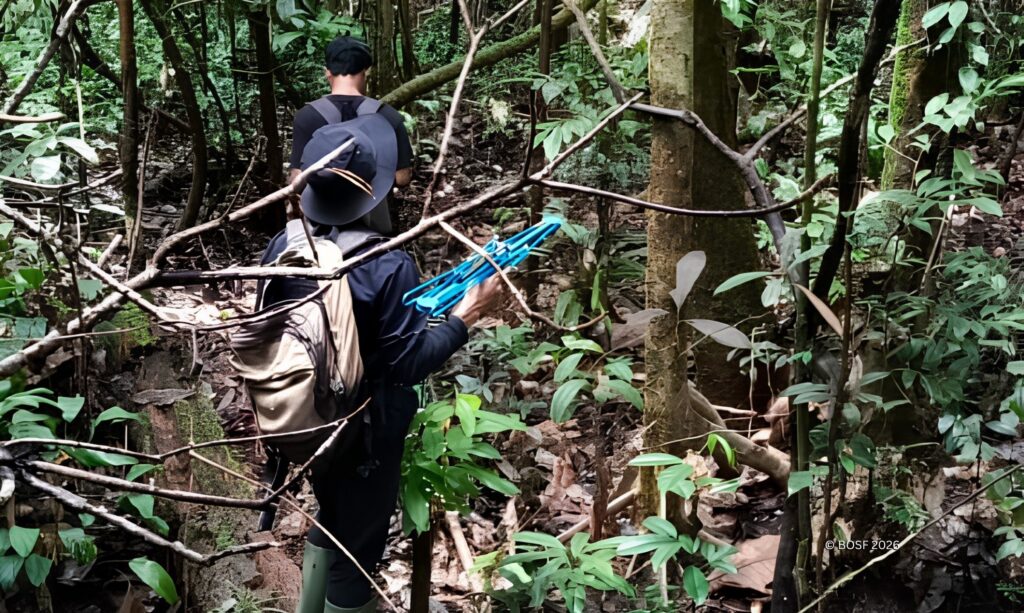
A release into the wild is often seen as the final chapter in an orangutan’s rehabilitation journey; however, for our Post Release Monitoring (PRM) teams, it is not. Discover what it takes to track a released orangutan in the wild.
Released orangutans are never left on their own. Deep within the forests of Central Kalimantan, our Post Release Monitoring team works every single day. There are no weekends here. The forest does not recognise Saturdays or Sundays, nor does the responsibility of safeguarding lives that have just been given a second chance.
The BOS Foundation PRM team in Central Kalimantan conducts monitoring activities from several camps across release sites, ranging from the Bukit Batikap Protected Forest to the Bukit Baka Bukit Raya National Park landscape. From these modest forest camps, daily journeys often begin before sunrise, following transects that stretch for kilometres through dense rainforest.
Searching for signals in the forest
Each released orangutan carries a small transmitter that emits a radio signal. This signal is the team’s first clue to the released orangutans’ whereabouts. Two PRM team members slowly walk along the transect. At the front, a tracker carries a GPS unit, an antenna, and a signal receiver. Every few hundred metres, they pause briefly, listening carefully for the distinctive “tek-tek” sound from the tracking device. When the familiar “tek-tek” signal appears, the atmosphere shifts instantly. The transmitter has detected an orangutan nearby.
Yet locating an orangutan is never as simple as reading coordinates on a screen. The team relies on all their senses: scanning the canopy, spotting old nests, detecting faint scents, and listening for movement in the branches high above. And when the orangutan finally comes into view, the real work begins.
Following a day in the life
Once an orangutan is found, the team shifts from searching to observing. The antenna is folded away, tracking equipment is stowed, and full attention is directed towards the forest’s resident.
From the moment of encounter until the orangutan builds its night nest, every behaviour is carefully recorded. This includes what the individual eats, how it moves, and whether it plays, rests, or interacts with others. Even small details, such as the type of fruit the specific orangutan selects and how it consumes it, become valuable scientific information.
Observations continue throughout the day, following the orangutan’s natural rhythm. Sometimes they feed while travelling through the canopy; at other times, they remain in a single tree for hours. At times, semi-wild individuals express discomfort with human presence through the distinctive “kiss squeak” vocalisation.

Each orangutan carries a small transmitter that sends a radio signal to a tracking device.
When the team encounters a mother with her infant, they divide responsibilities. One observer follows the mother, while the other records the young orangutan’s development and behaviour. These observations help researchers determine whether survival skills are successfully passed from one generation to the next.
The working day ends only when the orangutan builds its night nest and settles in to rest. GPS coordinates are recorded, the nesting tree is identified, and the team quietly withdraws, allowing the forest to return to silence.
Reading the forest, not just the orangutan
Monitoring orangutans means more than observing individuals. The team must also understand the condition of the forest they now call home.
Each month, phenology monitoring is conducted to assess natural food availability. Researchers observe trees along designated transects, recording the presence of young leaves, flower buds, blossoms, and ripening fruit. These data help answer a crucial question: can the forest provide sufficient food throughout the seasons? Because a healthy forest is the foundation of successful reintroduction.
In addition, regular nest surveys are conducted to assess population density and distribution patterns. Every nest discovered offers clues about movement, habitat preference, and how orangutans use space within the forest.
Simple observations of nest structure and condition reveal surprisingly rich insights into the hidden nighttime lives of orangutans, which humans rarely witness.
Extra eyes in the forest
Not all orangutans are easy to find. Some travel far beyond monitoring routes or choose remote areas rarely visited by people. To support monitoring efforts, camera traps are installed at strategic locations.

Researchers observe trees along designated transects, recording the presence of young leaves, flower buds, blossoms, and ripening fruit.
These silent observers capture moments of wildlife activity often missed during direct observation. Occasionally, images reveal orangutans that have not been monitored for long periods, providing renewed hope and guiding the team’s next tracking plans. Beyond orangutans, camera traps also record other wildlife species, demonstrating that the release ecosystem remains active and functioning.
From forest to data, from data to the future
Even after returning to camp, the work continues. All field notes are entered into research databases. Every recorded behaviour, feeding tree, and nesting location contributes to a broader understanding of rehabilitation success.
Using these data, the team can determine whether released orangutans can survive independently, find sufficient food, build suitable nests, and eventually reproduce in the wild. This is because the goal of reintroduction is not merely to release orangutans back into the forest, but also to ensure they have truly come home.
Behind every individual living freely in the forest canopy lies the dedication of a team that continues to walk beneath the trees each day, searching for signals, protecting hope, and ensuring that future generations of orangutans will always have a place to live in the wild.
Please find out more about our crucial conservation work here.