MOZA’S REMARKABLE JOURNEY
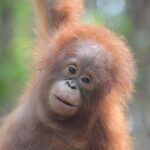
On September 13, 2015, a two-year-old female orangutan began a long journey back home to Indonesia. The young orangutan was later named Moza. After being rescued in Kuwait, she was repatriated to Indonesia through a collaboration between the Directorate General of Natural Resources and Ecosystem Conservation (Ditjen KSDAE) of the Ministry of Environment and Forestry (now the Ministry of Forestry) and the Embassy of the Republic of Indonesia in Kuwait.
Upon arriving in Indonesia, Moza underwent a quarantine period at Taman Safari Indonesia in Cisarua, Bogor. Veterinary examinations showed that the tiny infant was in good health. However, like many orangutans who once lived far from their natural habitat, Moza’s journey to becoming a true wild orangutan had only just begun.
Learning to Become a Wild Orangutan
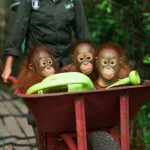
After completing quarantine, Moza joined the other orangutans at BOS Foundation’s Nyaru Menteng Orangutan Rehabilitation Centre in Central Kalimantan. Like her peers in Forest School, Moza went through various rehabilitation stages designed to help her regain her natural instincts.
She learned essential survival skills, such as climbing trees, identifying different forest food sources, and building nests for resting. Moza’s care team—comprising surrogate mothers, veterinarians, and dedicated animal welfare staff—carefully monitored her progress.
From the very beginning, Moza professed herself to be a quick learner and an intelligent individual. Her strong adaptability allowed her rehabilitation to progress relatively fast. After around four years of intensive learning in Forest School, Moza was finally considered ready to move on to the next stage.
Stepping into Semi-Wild Life and Becoming a Mother
In 2019, the team transferred Moza to a pre-release island. There, she gained greater freedom to explore, forage for food, and interact with her natural surroundings. Routine monitoring continued, although not as intensively as during Forest School, to ensure that her rehabilitation progress remained on track.
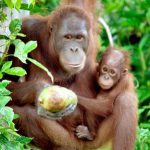
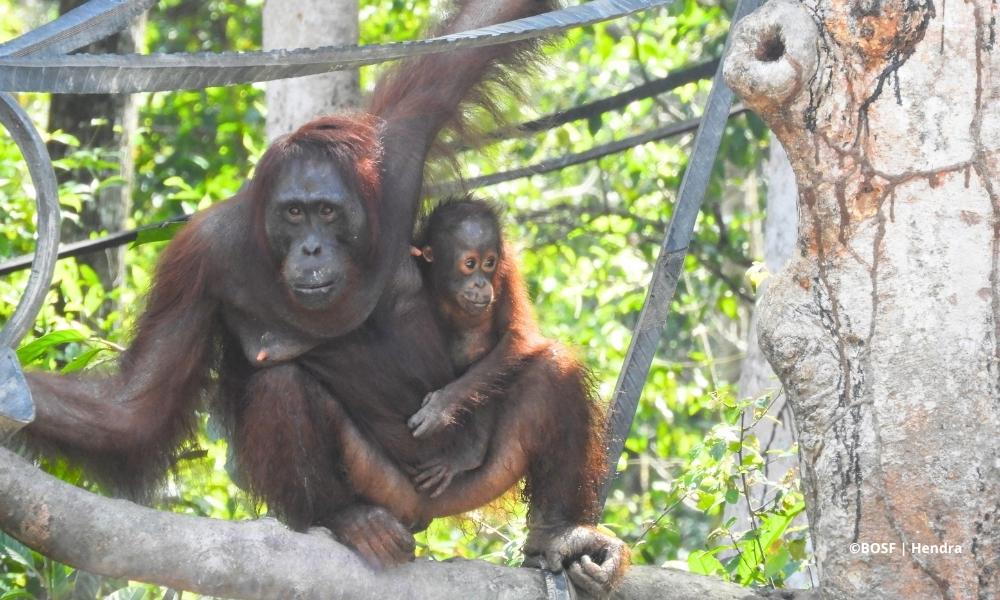
More than a decade after her first return to Indonesia, Moza has grown into an adult female orangutan estimated to be 15–16 years old. Her life has also entered a very important new chapter: she has become a mother. On Kaja Island, Moza is now caring for a young male orangutan named Minho, who we estimate to be around three to four years old.

Moza and her son, Minho, are enjoying a warm afternoon on the island, sitting by the beach and playing in the water.
During one observation session, our island observers spotted Moza and her infant in good condition. Our monitoring team first saw Moza sitting in a tree at a height of about 1 to 5 meters while enjoying her lunch. Minho mirrored his mother’s behaviour nearby. After finishing their meal, the pair slowly moved deeper into the canopy until they disappeared from the team’s view.
A Warm Moment by the River
On another observation day, the team saw Moza and Minho enjoying the warm afternoon on the island, delightfully playing in the water. Both mother and infant walked toward the water’s edge and began soaking themselves. Their interaction reflected the strong bond between mother and child.
This behaviour also forms an important part of Minho’s learning process. By allowing him to explore his surroundings, Moza is naturally teaching him the survival skills he will need in the future.
After finishing their playtime, Moza approached the feeding platform to enjoy the supplementary food provided by our technicians. Both mother and son eagerly finished the melon and papaya before continuing with the rest of their daily routines. Throughout the observation, Minho remained close to his mother.
A Journey Home that Brings Hope
Moza’s story is a reminder that every rescued orangutan carries new hope for the future of their species. Once a young individual living far from her natural habitat, Moza has now become a mother raising the next generation in a more natural environment.
Her long journey shows that with the right opportunity, orangutans can reclaim lives close to the wild. Today, beneath the forest canopy of Kaja Island, Moza and Minho continue preparing for the day when they may finally return to the forests of Kalimantan.