VITAL INTERACTIONS
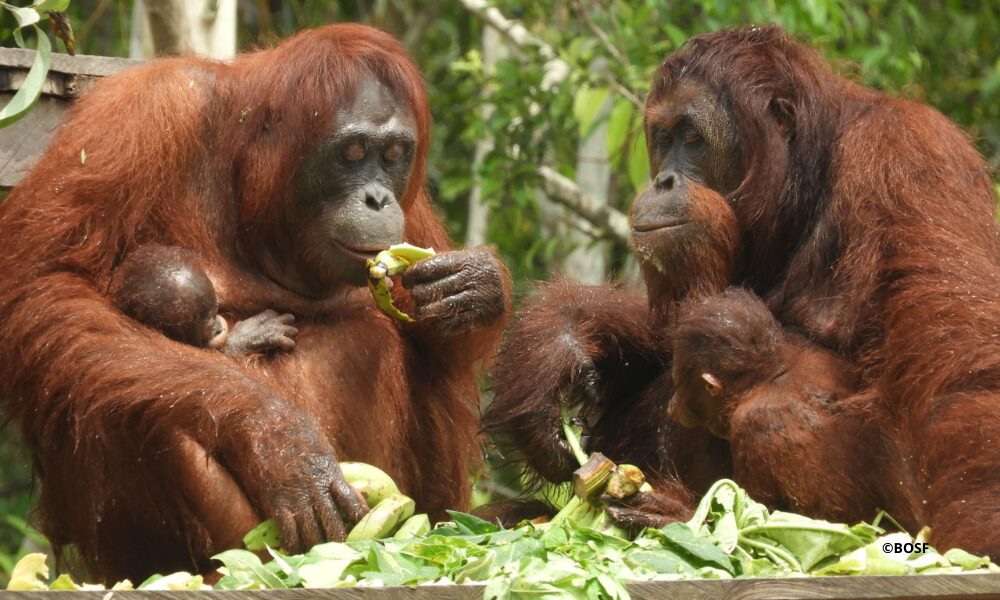
Do you remember the story of Sally and her little furry friend? That simple story actually offers a broader insight into our understanding of orangutan social behaviour. Although orangutans are often described as semi-solitary primates, they still possess both the need and the ability to engage in social interactions. Not only with their own kind, but also with other species.
Orangutans and Their Flexible Social Nature
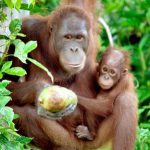
Most primate species are social animals. In orangutans, the semi-solitary trait is most apparent in adult males, who tend to have large home ranges and spend much of their time alone. In contrast, females and juveniles are still frequently involved in social interactions, whether for play, learning, or observing the behaviour of other individuals around them.
This innate behaviour does not disappear when orangutans are in rehabilitation centres. Interestingly, their social interactions are not limited to fellow orangutans. On several occasions, orangutans have also been observed interacting with other species. One such example is the interaction between Koko and Winey and long-tailed macaques (Macaca fascicularis) on Badak Kecil Pre-Release Island.
Learning Cross-Species Interaction from Koko and Winey
While consuming supplementary food at the feeding platform on Badak Kecil Island, Koko was observed sharing her snacks with a long-tailed macaque. Not only that, Koko displayed intriguing behaviour, such as rubbing or dipping fruits like melons and bananas into the river before eating them, as if she were “washing” them. She also appeared unbothered by the macaque’s presence. Koko took only the additional food she needed and allowed the macaque to take the rest.
At another time, Winey was also observed “party” with long-tailed macaques on Badak Kecil Island. Winey and the macaques were seen actively swinging together from one tree to another. Previously, Winey had also been observed interacting with long-tailed macaques while she was still at the Nyaru Menteng Forest School. Although she is known to be highly vigilant toward other orangutans, Winey still demonstrated tolerance and cross-species interaction without conflict.

Orangutan Koko is sharing her snacks with a long-tailed macaque on a feeding platform.
Why Are These Social Interactions Important for Orangutans?
Social interaction plays a crucial role in the learning process of orangutans. Through observation and imitation, orangutans learn to recognise adaptive behaviours essential for survival, such as selecting and foraging for food, identifying potential threats, and interpreting their surroundings.
Interactions, including those with other species, also contribute to the development of cognitive and emotional skills, such as tolerance, emotional regulation, and the ability to understand social boundaries.
Moreover, early social interactions serve as a natural simulation of the complexity of forest ecosystems. In the wild, orangutans share their habitat with many other species, making the ability to adapt to the presence of other animals an important part of their readiness for life in the forest.
Orangutans that demonstrate flexible and context-appropriate social interactions reflect behavioural development toward independence and serve as an important indicator that an individual is increasingly ready for release and independent life in its natural habitat.
Social Interaction as Part of a Long Adaptation Process
The stories of Koko, Winey, Sally, and their unique interactions with other species show that rehabilitation centres are not only places for physical recovery, but also vital spaces for social learning. Cross-species interactions are part of the natural process of shaping orangutan behaviour before they return to their natural habitats.
Through continued observation and understanding of these behaviours, we are reminded that orangutan conservation is not only about saving individuals but also about ensuring they are equipped with the behavioural skills necessary to live as part of a complete, functioning forest ecosystem.
Scientific References
- Russon, A. E. (2009). Orangutan rehabilitation and reintroduction. Orangutans: Geographic variation in behavioral ecology and conservation, 327-350.
- Maestripieri, D. (2006). Among Orangutans: Red Apes And The Rise Of Human Culture. By Carel van Schaik. Cambridge, MA: Harvard University Press. 2004. 244 pp. ISBN 0-674-01577-0.
- Schuppli, C., Forss, S. I., Meulman, E. J., Zweifel, N., Lee, K. C., Rukmana, E., … & van Schaik, C. P. (2016). Development of foraging skills in two orangutan populations: needing to learn or needing to grow?. Frontiers in zoology, 13(1), 43.
- Jaeggi, A. V., & Van Schaik, C. P. (2011). The evolution of food sharing in primates. Behavioral Ecology and Sociobiology, 65(11), 2125-2140.